Welcome!

Welcome to theopinionatedinternet.blogspot.com, a whirling hotpot of political opinion, poetry, prose, philosophy, reviewing, and other assorted wild ramblings! Here you will find: PWN, Grand Reviewer and assistant thinker; JAFHR, head of Philosophy, Literature, and Ambassador for France; JHWW, critic/comic materialist; and iTech, computer technician, pilot-in-the-making and co-politician. Fare Thee Well!


Pour les Francophones

Cher Lecteur/lectrice,
Nous vous souhaitons la bienvenue A notre blog, L'Internet Dogmatique. Vous trouverez ici tout votre bonheur- Literature, Philosophie, Politique, Revues, Technologie... Par dessus tout, vous trouverez des opinions. Ne manquez pas a publiez le votre!
Pour rendre tout cet Anglais lisible, traduisez simplement cette page en utilisant le gadget que vous trouverez sur votre droite, un peu en bas. Nous regrettons que cette traduction est rarement exacte; il serait peut-etre plus sage d'utiliser ce blog pour pratiquer votre Anglais.
Bien le Bonjour, Messires et Demoiselles,
JAFHR, le Fou Francophone.

Saturday, April 28, 2012

FRENCH ELECTIONS 2012- Review of Candidates

I will attempt to make this post unbiased, however I am not always able to control my repulsion towards the Left.---JAFHR.

Sunday 22 April 2012- First round of the French Presidential Elections.

Right Wing                                                   Blue

Based on: Liberty; Tradition & the Legacy of the Past; upholding the valours of the Republic, creating a sustainable government in which all may profit, and in which the past is respected, the present is dealt with efficiently, and the future is prepared.

Left Wing                                                     Red

Based on: Equality; Poverty, and the Needs of the Present; creating a country in which all differences are abolished and wealth is taken from those who earn it to be distributed among the lower classes, and to solve present problems. 
  • Candidates:

Nicholas Sarkozy, right-wing (moderate), 27% chances of winning. 
Francois Hollande, left-wing (socialist), 27% chances of winning.
Marine Le Pen, right-wing (National Front), 16% chances of winning. 
Jean-Luc Melenchon, left-wing (Trotskist), 14% chances of winning. 


Francois Bayrou, centre, 10.5% chances of winning.

    Eva Joly, left-wing (Green Socialist), 3% chances of winning. 
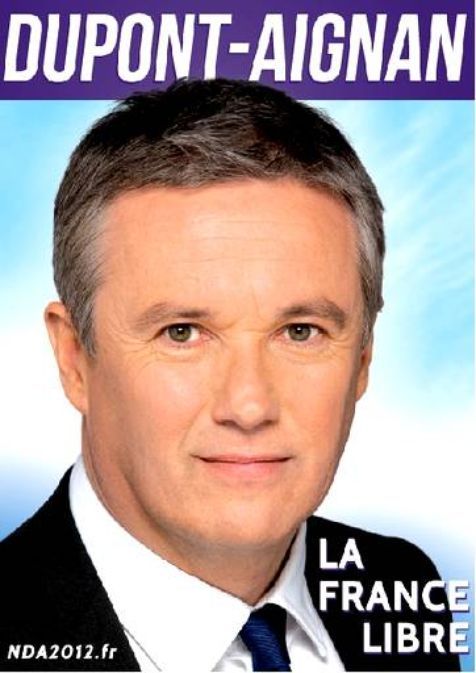
Nicholas Dupont-Aignan, left-wing (moderate), 1.5% chances of winning. 
Phillipe Poutou, left-wing (Anti-capitalist), 1% chances of winning.
Nathalie Arthaud, left wing (Communist, the 'Workers' Struggle party'), 0.5 % chances of winning
Jacques Cheminade, left-wing (socialist), 0% chances of winning.


Policies of each Candidate- and a commentary of each:

SARKOZY

Slogan: La France Forte- A Strong France.
Aims:
  • Globalization- to increase France's external trade, communication, diplomacy and general involvement. Seems quite vague but realistic- no great sums of money involved.
  • Safety from the negative side of Globalization- to restrict immigration, by ensuring that anyone who does not know French language and the valours of French Democracy cannot settle in France. A good idea considering recent problems, but risky to public image.
  • Safety- to direct more money towards 'The Forces of order'- Police Forces. Vague, but the only problem I foresee is increased tax.
  • Preservation of French Identity- To make anti-French propaganda illegal- a good idea, but could be interpreted as an assault to freedom of speech.
  • Familial rights- to preserve the lessening of taxes for families, and to increase teachers' salary. First part- fine by me, though any lessening of taxes in one direction means an increase of taxes in another. Second part: I have found that most teachers in Britain and France are socialist, and this may simply be an attempt to befriend them.
  • Fiscal Justice: To abolish a whole range of fiscal frauds and cheats which permit some to cheat the government. This includes 'Capped retirements' and 'Golden parachutes'.
  • Poverty: To lower Social charges for those who receive no more than 1400 euro/month. Charitable, but risky; would result in a tax increase,
  • Education: to create more teaching jobs for children who need special (clinical) treatment.
  • Lone Parents: To create an agency, the aim of which is to help lone parents. This ranges from physical aid to lowering taxes. Costly.
  • Transportation: To improve the public transport in rural France. Costly, so there may well be an increase in taxes...
  • Debt: to invest with the money given by taxes, so as to quickly and efficiently pay off debt. Interesting idea- never tried before, could just work...
  • Overall impression: As Sarkozy has already put most of his other plans into operation, he does not have much more to promise. The program seems feasible, and the taxation seems just, although his stance towards immigration does not help his public image.

HOLLANDE

Slogan: Le Changement C'est Maintenant- Change is for Now.
Aims:

  • To create a government-owned bank, so as to control the financial situation. Seems to me quite an odd idea, as this would just cost the government more money and cripple the already-existing banking industry.
  • To modulate a number of taxes- in particular, the Society Tax. This is to 'Cut some Slack' for small businesses. Seems to me that this would cripple France's Overseas business opportunities.
  • Steal From the Rich: to impose a massive 'Fortune tax' for those who gain more than €1,000,000 /year, and taxing any 'Unconventional profiting' at 75%... The new government would need a lot of taxes to pay off its massive ideas; this money will be gained off those who earn more money.
  • Give to the Poor: The State will freely give its lands to social housing projects. This is probably never going to happen- there would be a resulting befuddlement of housing prices, and a dramatic raise of taxes (for wealthy people only).
  • Slowly lowering the Nuclear energy from 75% to 50%. This would likewise increase Energy taxes to unprecedented levels; Hollande is probably saying this to strengthen his alliance with the Greens.
  • Massive taxation of financial transactions, and restricting speculation in private banks- to lessen the power of financial industry. A growing percentage of France works in finance- to cripple finance may not be good for the unemployment rate.
  • Hollande promises that the economy will be stabilized by 2017- the year he is to (?) leave office. Interesting timing...
  • To renegotiate the Austerity treaty in order to let countries grow. How a higher debt can make a country rich, I have yet to discover...
  • Somehow Hollande promises to stabilise the prices of oil, natural gas, water and medication- the only way to do this would be for the state to pay the surplus, which would mean an extra tax...
  • More Jobs- To create 150000 jobs for 'Less qualified youths'. This will probably involve much bin-cleaning and other lowly governmental jobs; where will their salary come from? Taxes, taxes...
  • To ameliorate schooling; by spending more money on teachers' training, and to create 6000 more teaching jobs. Nothing really different from Sarkozy's plans, but the tax problem is still an issue.
  • Discrimination: to 'fight Antisemitism and racism as strongly as resources permit us' (not mentioning any methods); a 'Handicap screen' will be added to each law (strange idea, which many handicapped may feel is separating them from society); and all couples will henceforth be allowed to marry and adopt (which is a complete reversal of the Constitution, an will be very unpopular).
  • Police work: Much of the budget will be going into the reformation of the police and the justice system, which will be made independent. (How on earth is that going to work?)
  • Finally, Hollande talks of the befriending of the Southern bank of the Mediterranean, and the Arab countries (no plans for the resulting immigration...). He also talks of ending the Afghanistan war by 2013- so we lose our relationship with USA, to ally with Arabia. Charming.
Overall impression: Hollande's plans seem very, very expensive. the money is to come from taxes- Hollande talks of giving free lands, but we will in fact have paid for them in taxes- and Hollande intends most of these astronomical prices to be payed by the higher classes, those who have worked harder to earn their success. There are not enough successes in France to pay for these expensive schemes, thus eventually it will fall to the lower classes to pay for the extravagant plans of an irresponsible government. Not a good idea to vote in that direction.

LEPEN

Slogan: Oui, la France; Approve of France
Aims:

  • Independence- to end certain treaties with Europe and America, in order to retain financial and military independence; to only fight wars when France is at stake. Doesn't seem a good idea to alienate all our allies...
  • Security- to create 150000 more police jobs, and to create 'the true meaning of Zero Tolerance.' The police business seems quite expensive, though Marine mentions that these jobs did once exist in Chirac's time (thus she would not be creating but re-instituting), and the reason they were removed were not financial- if Chirac could afford more police, why not her?
  • Immigration-  to get rid of all illegal immigration and to drastically decrease legal immigration; to remove all  temptation to migrate, and to instigate a 'National job priority' for French workers. This could all be seen as discrimination, especially the last bit- yet, if we don't delve into ethics, it would be a good idea- we would feel a short demographical plunge and a befuddlement of prices, but the country would come out the richer within three years' time. The only problem is the reaction of other countries.
  • Secularism- to remove all traces of religion from the government and from the law- "freedom of belief is guaranteed, but the principles of the Republic (secularism) are non-negotiable." It would appear that Marine is talking about Islam. After all, she is only enforcing a ready-made law.
  • Financial markets- to 'End the Dictatorship' of financial markets, by installing a stronger government. Doesn't really mean anything.
  • Family- to create a lessening of taxes for parents. Typical- forgets to mention that the taxes will have to come from another direction...
  • School culture- to change the scholar program, in order to cultivate our children in the way of the country's history, and moral principles. This would bring us into the world of philosophy, which is not fit for this particular post.
  • To improve housing. A simple yet costly plan, which, once again, evokes the shadow of taxation.
Overall impression: The lack of economic plans seems a major drawback, and Le Pen's hostility towards the rest of the world seems unlikely to gain her many partisans.

MELENCHON

Slogan: Prenez le Pouvoir; Take Hold of Power.
Aims
  • Finance: Banning of all speculation. Never going to work- much more likely that speculation will be taxed excessively. 
  • Creation of a public bank, to control debt. As with Hollande, this is not likely to work.
  • To free France from all EU treaties and contracts- effectively leaving the EU. Bad for finance and disastrous for diplomacy...
  • Repose- only allowed to work 35 hours/week, forced to have two days off every week. Disastrous on all counts, from individuals to economy.
  • Salaries- Minimum salary increased to €1700, and plans to get this in operation for the whole of Europe, to stop 'Unfair competition'. Bad for finance, disastrous considering that no other country would agree- especially after the breaking of the Lisbon treaty.
  • Religion: Stopping all government expense on religious needs & buildings. This is done in the name of secularism, but to me it has crossed the line to atheism.
  • Eco-friendly: to get rid of carbonic energy (EXPENSIVE); to introduce more renewable energy (EVEN MORE EXPENSIVE), and to reduce nuclear energy (POINTLESS).
  • To make life-sustaining energy and water free. Firstly, this will make a heavy load of taxes. Secondly, how does one define 'Life-sustaining'?
  • Health- to reimburse 100% of health costs. This is already (more or less) in operation, but only accessible to French citizens; since Melenchon wishes to redefine French Citizenship and allow anyone to claim it, this would mean a massive increase in health taxes.
I was not able to uncover much more, as most of Melenchon's programme contains fruitless waffling, like 'supporting peasant agriculture'.

Overall Impression: Generally unrealistic. Most of this ignores the devastating economic/tax effects, or the fact that other countries would intervene.

Yours in Politics,
Your friend,
JAFHR

The French Elections

Good Day to All.
As I am French, I will be spending the best part of these troubled weeks talking about the Elections. Just thought you ought to know. Consider it a series.
Good Day,
JAFHR

Monday, April 23, 2012

FRENCH ELECTIONS 2012- First Round Results.

Hollande: 28.5%
MORE than polls predicted. As I have previously discoursed, this is not good for France; yet it is just as I expected, considering the psychology used in Hollande's campaign.
Sarkozy: 26.1%
LESS than polls predicted. Not bad considering LePen's followers, yet this is the first incumbent president who has ever lost in a first round. Cause for worry.
LePen: 18.5%
MORE than polls predicted. An unexpectedly powerful political figure- where will her voters now go? Many express the opinion of 'Anything but Sarkozy', while others may be true Right-wingers... In her speech she did not mention backing anyone up, which is distressful but to be expected- she cannot support left-wing, but she can't support someone whom she has been criticising for five years.
Melenchon: 11.5%
LESS than polls predicted. Melenchon's speech was all about defeating Sarkozy, not supporting Hollande. We have already seen that Melenchon works by destruction, not construction.
Bayrou: 8.5%
LESS than polls predicted. Will make his intentions public in the next few days, it is however unlikely that he will support Sarkozy.
Joly: 3%
LESS than expected.
Dupont-Aignan: 1.5%
LESS than expected.
Nathalie Arthaud: 0.7%
MORE than expected.
Philipe Poutou: 0.5%
LESS than expected.
Francois Cheminade: 0.3%
MORE than expected.


-JAFHR-

Wednesday, April 4, 2012

A Busy Day

Greetings; 'tis I, JAFHR.
I have a few announcements to make.
  • I have a couple of websites to advertise:
  1. I have just made a blog, named thefolkloristslair.blogspot.com, which is a repertoire of my arcane folkloric knowledge;
  2. Catholicfire.blogspot.com, which I strongly recommend for religious nuts like me.
  3. leblognadel.over-blog.com, which I include as a sort of joke as it's in French. It's the blog of Gilles William Goldnadel, a politician whom I frequently quote from.
  • Secondly, I would like to present my brother, whom you will know as Pimbear. Pimbear is fond of Horror stories and other cool pieces of literature (he mentions H.P.Lovecraft and Tolkien); he is also fond of bears, and, although he is not going to sound as mad as I am, he has the potential.


  • Lastly, I would warn you all that JHWW is going to be back and blogging by Easter. He probably doesn't know when that is, so you have time to BRACE YOURSELVES!
Beware the Cheeseman...
Cordially,


Pimbear
JAFHR

Monday, April 2, 2012

Syncretism

Good Day.
Today I shall be explaining something which most people do not realise about religion. Most people are likely to think that, when a religion colonises a country, it gets rid of all traces of previous religions. Right? Well, not quite. This is a demonstration of why this is not the case.
My most obvious example is Scandinavia. Picture yourself as a Christian missionary, sent to Oslo to found a church with nothing but a sack of beans (provisions) and a few fellow churchmen. Many people in the 21st century like to say that missionaries converted people by force. Well, here is a sample of Viking mythology:
  • Odin- god of war strategy.
  • Thor- god of fighting.
  • Loki- another strategist.
  • Bragi- wartime poet.
  • Niord- god of the navy, and of wartime provisions.

Maybe I am stretching it a bit, but my point is that Scandinavia was very much centred on war.

It was about the fiercest, most powerful nation in Northern Europe, and its empire stretched from Greenland to Russia, passing through Scotland, Yorkshire, Normandy, and even Spain and Lombardy, plus one short glimpse of Manhattan. Each and every peasant in this hard land knew how to use a weapon, if only a pitchfork. So how on earth are you, a 'geekish' young priest (meaning you know how to read) , supposed to convert them by force?
So, how are you going to convert them? Firstly, you need to gain their trust. To do that, you need to know their beliefs and customs. So, you learn of the Norse mythology, and the knowledge turns out to be very useful...
The Christian God is all-powerful, all-knowing, and so on-right? Well, the Norse gods, along with most polytheistic gods, are not omnipotent- they are sinful, and their powers are limited, and many are mortal. So you use the Christian idea of angels; angels are messengers of God, right? So you say that the Pagan gods were in fact sent by God to 'prepare the way' for Christianity. The gods are in fact angels; messengers. That way, you haven't contradicted the pagans, but you have added to their store of knowledge (or so they feel). With the vikings, this was particularly effective, as the y believed that all their gods were to die one day, at the Ragnarok. The missionaries said that Ragnarok had already come, and that, once the gods had died, God had taken over the rule of the world.
With this wonderful tactic- agreeing with the native beliefs, yet getting your own religion across- many religions flourished. Islam, for example, made its way into Africa and Persia by agreeing with the native communities on certain counts- for example, Islam talks of Djinns, nature spirits which actually came from Persia. Various strands of Buddhism believe in various deities- Shinto Buddhism, for example, or Greater-Vehicle Buddhism- and they all say that the 'gods' are in fact a greater level of reincarnation, or creatures which help you reach Nirvana.
In conclusion, you deserve to be lied at if you believe that religions are always at each others' throats. This tactic of agreement is named Syncretism; I thought you may want to be aware of it, after that post on Buddhism I made.
Greatest respects,
Your friend,
JAFHR

Saturday, March 24, 2012

My Precious Soliloquy - Smeagol

My Precious...
It's mine... my own... my precious...
So bright... So beautiful... it's shining, glinting so brightlike...
But here, where we's so far away from the Yellow face, where does it gets its lights?
The Yellow face... too bright, leering at us, teasing us... Teasing we can't climb our way free, like it does, the nasty Yellow face... too high, too teasing... like nasty elves...  bright eyes... Precious doesn't tease... precious helps, helps bring us high like bright Yellow face... precious understands... too hard to be high like yellow face... better to eat what precious finds us... precious is kind... fishes and goblinses and ratses... precious finds food... so bright... so beautiful.
The noises, precious! What's the noises?
Nothing, my love... just goblinses, goblinses hurrying down tunnels, with dwarves and stings... Stings... They drove us away with stings, precious, when we finds you... my birthday... my birthday present... mine... the other one, he couldn't have it, it was mine, my birthday, my own, he couldn't have it...
Goblinses is awfully noisy, precious...
A fish, precious, in the pool... look how it wriggles... catch a fish... so juicy sweet... 
Sweet, my love? What is juicy sweet? We is never heard of juicy sweet before...
Yes, precious... we just hears of it in bright land, land of Yellow face...
Yellow? What  is yellow, my love?We is never heard of nasty word before...
Yellow is a colours, precious...
Colour, my love? What colours is there but blacks and greys and muddy browns? There is no bright lands, my love, no yellow face. There is just the Precious... My precious... So bright... So beautiful... look at it, my love... so perfectly round...
It's Mine!
JAFHR

Thursday, March 22, 2012

The Absence of a Twerp

Dear All,
JHWW has asked me to tell you that his absence in the past few weeks is due to his 'abstaining from Blogging', his Lenten resolution. Sadly, he will soon be back and active. 'Brace yourselves' says he...
JAFHR
Beware the Cheeseman...

Tuesday, March 13, 2012

A Rant on Buddhism

Good morrow to thee once more.
Today, I shall be discussing a train of thought which holds much sway on modern Western philosophers; I am talking, of course, about Buddhism.

It has come to my attention that those in my immediate vicinity know little or nothing about Buddhism, and so resort to the crude stereotype of the sage, nature-loving Tibetan monk. People tend to throw around the word 'deep', not really knowing what it means themselves.


Perhaps I should seize this opportunity to give a lecture on human nature; we are fascinated by the unknown, the new, that which is out of the mundane. We are always inspired and enchanted by anything straying from ordinary life; we subconsciously assume that anywhere and anything has to be better than our own lives.
So, since we are easily seduced by anything new to us, it is little wonder that this enchanting new philosophy from the Far-East makes us dream not only is it conveniently exotic, but it is also advanced and deep enough to enchant those members of our community with a brain.
Those who know almost nothing of Buddhism are quite ready to believe that anyone leading a Buddhist life is wise and peaceful and whatnot, while someone who studies the subject is enchanted by the finesse of Buddhist thinking- the 'Way of  the Middle' or the 'Noble Truths' are 'deep' enough to captivate the philosopher who views them with the eye of a Westerner.


This fascination for the unknown also works the other way; Christianity has been in Europe too long, and people have lost interest in it. The press dramatically emphasizes anything which is wrong with the church, knowing that the people will just go with what they say, and thousands of unbalanced arguments are hauled against the Pope each day.
There is also the matter of the Crusades; people often say that the Church is evil, because it ordered that war. People then turn, dewy-eyed, to Buddhism, seeing the facade of peaceful meditation.


Yet what do we uncover, if the shroud of mysticism is taken off? We find that Buddhism slaughtered its way into Mongolia; we find that its arrival in Japan caused several decades of civil war, and bereaved the Emperor of most of his power; we find that many Chinese and Japanese emperors and leaders were assassinated or  executed because they did not follow Buddhism to the letter; we find that, contrary to popular belief, Buddhist meditation is no more or less mystical than Christian prayer. Nay, Buddhism is not an innocent as some would have us think.


Having said this, it is true that certain Buddhist ideas are 'deep' indeed; yet they are not one-of-a-kind. Most Buddhist principles-like "Desire is the cause of all suffering", for example- have also been discovered by Greek philosophers. The aforementioned statement is the fundamental truth of Stoicism as well as Buddhism; if one is going to become engrossed with such ideas, why go any further than Greece? Germany has also produced a recent spout of excellent philosophers, and so, for that matter, has France. And Jesus himself is quite a match for Buddha, and I may go so far as to say that they have much in common. Both supported charity, both taught their followers how to reach a peaceful light after death- whether Nirvana or Heaven- and both went through periods of starvation, self-denial and other sufferings. Christianity and Buddhism also have much in common.
My point is, we have much wisdom on our own turf, there is no
need to go snatching some off others. 
I would finish off by telling you the sad anecdote which brought me to write this;  I met a very odd fellow, who sometimes used the names of different religions as adjectives. According to him, 'Muslim' means good, 'Jewish' means isolated... refraining myself from commenting, I asked him what 'Christian' meant; he said it meant 'Bad'. I had already guessed what Buddhism meant, but I asked him anyway; guess what? 'Deep'. I asked him what Taoism meant; he said he didn't know what it was, but as soon as I told him it was Chinese, he told me it also meant 'Deep'. If he'd known anything about Taoism, he'd know that Lao Tzeu would have wished him to abide by the religion of his country.


I have published the conversation which ensued, as it seems essential to include opposing opinions.


PWN- This is one of the most poorly considered and biased posts I have ever seen. You are arguing against a viewpoint which is not held by any anymore. Your allegations against the press are completely unfounded, as is what you say about the Pope. You said that Christianity has been around for too long, with people no longer taking an interest. Buddhasim has been around for hundreds more years, and all your criticisms of it are from at least half a millennium ago. Christianity is far more likely to have stolen frm Buddhist Philosphy rather than the other way round and Christianity and Islam cause more violence today than Buddhism. What makes Buddhism important is its appeal to people who would otherwise be atheist or agnostic. It gives people who cannot believe in a god a spiritual side and you're acting as if it's a bad thing. Christianity is not comparable to Budhisim, they both compliment each other; rather than stealing or contradicting as you imply. There is no need to choose between them, their philosophies are fundamentally based on the same principles of morality and altruism. What is the point of criticizing a religion in this way? Budhisim has reached a higher level of
My apologies for not finishing my post, my iPad glitched out. Perhaps it's for the best; I would never have finished otherwise.


JAFHR- Poorly considered? Look at your own arguments; for example, who said anything about stealing ideas? And your understanding of Asian beliefs seems rather crude, perhaps because you only know of Buddhism through teachers. The most interesting thing about them is that many and most Asians find a way to follow more than one religion. Take Japan for instance- Shintoism, Buddhism, Confucianism, and Taoism, all melted into one culture! When Christianity reached Asia, the priests used Buddhist principles, and compared them to Christian ideas; all those in China and Japan who followed Christianity treated it just as they had once treated Buddhism- they called heaven 'Nirvana', and called God 'The Tao', or 'The Great Mandarin', or 'The Hidden Kami'. The two religions are compatible.
I do NOT imply anything like stealing or contradicting. I take my philosophical sources from all over the world, as you should know by now; I find that Buddhist philosophy sometimes helps to understand Christian ideas, just as science does sometimes. There is much wisdom in the orient, of that I have no doubt; what I am criticizing is the fact that people forget the wisdom on our home turf. I stand by my point about Asian philosophers wanting people to follow the religion of their home land- an idea of tradition which I have echoed in my Summary, which you have obviously not read.
People who study the inner workings of Buddhism will find that the notion of a God is prominent indeed; Taoism, a philosophy adopted by Buddhism, worships the essence of the universe itself (this, in European, is called a 'God') as a deity. Beyond that, there are many types of Buddhism, most of which recognize the existence of Gods, but class them as 'lesser beings' or incarnations,compared to the greater being- some call it the Tao, some call it Death, and some (me included, sort of) call it God. If you read my Summary you will see that I agree with all of the above.
Christianity causes more suffering than Buddhism, you say? Let me remove the ridiculous 'Time' argument out of the way; how about the invasion of China by Japan, in WW2? Granted, that was not an entirely Buddhist action, but more sparked by Shinto-nationalism. Well then, Shimabara? Guiyang? Mitoshima? Each a massacre of Christians, each in the past three-or-four hundred years. Buddhism has no hold of any country right now- officially, China is strictly atheist; Japan emphasizes its Shintoist side; and Buddhism has left India. It is hardly fair to say that Buddhism is more peaceful. I might add that the Chinese revolution was sparked when a dangerous branch of Tao-Buddhism met Communism. Then we see that Buddhism was actually banned from Communist China; didn't you say that China was not bored of Buddhism? I am sure that banning Christianity in England would provoke a wave of fervour.


I shall publish two posts following this, to deal with your last points. I look forward to batting down more.

Hoping you understand,
Your good friend, 
JAFHR

Saturday, March 10, 2012

Video Games Violence isn't that Bad or: How I Stopped Worrying and Learned to Love Blood and Gore

Please bear in mind that all information given in this post is relevant to the UK only. For information about the age rating system in other countries, please consult this website.

First-person shooter season is over and not only does this mean that EA and Activision have stopped releasing games, it's also given a bunch of people some time to get really rather annoyed. No, it is not the thousands of disappointed fans, shocked to discover that the latest Brawl of Duty: Modern Gorefare game is not quite as new as they had expected it to be, instead, it is those most humble of creatures: parents. They have been shocked as they see the huge amounts of violence in these games, and take to the streets to protest. Sort-of. I would join these protesters and write a long post about how needless violence in games is and all that, but someone else already did that. And they had lots of sciencey stuff in their's, so I can't really compete.

Instead, I shall try to put the arguments of the other side, so often expressed in language that is filled with so much profanity that it is difficult to agree with the ****s. So it is with a slight amount of regret that I dive into my three reasons why people should stop worrying and learn to love blood and gore:

1) The Age Rating System

It is mainly parents who complain about violence in video games. If a game has an age rating which is older than the person who is attempting to purchase it (as long as it is rated by the Entertainment Software Rating Board, not Pan European Game Information which has no legal power inside the UK), then any decent member of retail staff would refuse to sell it to them. If a child is able to buy and play video game of which the parent is unaware then I would blame that on the parent. Does your seven-year-old need to know your credit card number? Really?

2) Violence Exists

The above statement is a fact; violence exists. So isn't it more important to tackle actual violence rather than objecting to events that never really happen or directly harm anyone? However, as the anti-video-game-violence-I-love-hyphens-protester would say, video game violence contributes to real-world violence. But does it? Well... maybe a bit. Despite this, most violence is caused by desperation. Desperation is caused by poverty, poverty is caused by unemployment, unemployment is caused by a lack of jobs and a lack of jobs is caused by the decline of companies. So by campaigning against video games (and therefore the companies that make them), aiming to send them into bankruptcy, aren't anti-video-game-violence-I-love-hyphens-protesters causing real world violence at least as much as the games they hate so very much?

3) The Army

The idea that more people are complaining about video game violence than the existence of the army seems rather strange. There are two reasons why this is happening: firstly, video games are quite an easy target, as they are big companies which are often seen as exploiting the average consumer through over-pricing and suchlike; secondly, significantly more families have directly experienced Call of Duty than front-line combat. An irony that is often pointed out is that one can serve in the army at seventeen, while Call of Duty is rated eighteen-plus. Furthermore, in Northern Africa children are actually being forced to fight by people like Joseph Kony, while here in Europe we're making all this fuss about children playing games which simulate combat (normally in a highly unrealistic manner). Does that make sense to you?


I end with a quote for Hunter S. Thompson (I think that fact that I'm quoting from a man who shot himself aged sixty-seven proves the point I made at the beginning that violence in video games is something to be avoided, but I stand by its relevance nonetheless):


'I hate to advocate drugs, alcohol, violence, or insanity to anyone, but they've always worked for me.'


-PWN-

iFAQ: History

What colour were the dinosaurs?

The fact is, we don't know. There are a few isolated cases where scientists have managed to work out exactly what colour dinosaurs were but for monsters like the Tyrannosaurus Rex, they can only guess. It would probably be a shade of green or brown to provide camouflage, which may sound stupid because Tyrannosauruses were so big they couldn't hide but it did make a difference while hunting, albeit a very small one.

 What was the biggest battle ever?

The biggest recorded battle in English history was the Battle of Towton where one tenth of the English population participated. That is a massive amount of people, however you look at it. It took place in 1461 during the Wars of the Roses and resulted in about 7,000 casualties. The biggest battle ever was probably the Battle of Kursk between the Nazi Germans in World War II and the Russians. It involved about two million soldiers. It took place in Kursk, Russia, in the summer of 1943.

When was the Automobile Invented?

That depends on your definition of 'automobile'. The Ford Model T is the most famous of all the motoring firsts, as the first car to be produced by mass manufacture. The Ford was produced first in 1908, but was only mass manufactured from 1911. Most people would credit Karl Benz with inventing the automobile as we know it in 1885 with the Benz Motorwagen. As early as 1335, the Italian engineer Guido da Vigevano
 designed (and supposedly built) a vehicle that moved using wind power, but this was more of a boat than a car. 

-PWN-

Sunday, March 4, 2012

The Infinite Original Plotlines

I was very much angered to read a list of what are supposed to be the 'seven original plots':

1) [wo]man vs. nature 

2) [wo]man vs. man 

3) [wo]man vs. the environment 

4) [wo]man vs. machines/technology 

5) [wo]man vs. the supernatural 
6) [wo]man vs. self 
7) [wo]man vs. god/religion 


Whoever wrote these is an idiot for the following reasons:

1) These are not plots, they are types of conflict. In fact, they're not even types of conflict, they're types of things that can be engaged in conflict.

2) What about Nature vs. Nature? Or Machines vs. Machines?

3) That list does not help understand anything in the slightest. What's the point of categorizing things in this way?

4) Not every main storyline is about conflict. Admittedly, most are, but what about romance? Okay, perhaps that is conflict, and there could be conflict on the side, but doesn't romance make more sense for a list like this?


I found some other lists that seemed to make more sense and although I find the concept interesting, I don't think it's very important or useful to categorize plots in this way.


-PWN-

Thursday, March 1, 2012

The Pointlessness of Social Networks

Once more I greet thee, good sir.
PWN was going to publish some Social Network business (though he gave up), so I thought I'd tell you what my philosophy has to say on the matter.


I seem to be just about the only person in my class who thinks that "Tweeting" or Facebook is a waste of time. Well, here goes; there is no point whatsoever in staying on a computer for hours, telling your friends that you are eating scrambled eggs. Yes, it has come to my attention that people who have really caught the Facebug want to stay on the computer, and so find nothing better to do than to pass the time by telling each other the most useless information ever found before on the web. They justify this with the simple statement that they want to keep in contact with their friends-most of which they meet daily. I think that computers and technology can be quite addicting.

You will probably say that I'm being too harsh? Well, maybe, but the simple fact remains that it is harder to look away from a flashing screen than a sheet of paper. I do not think that this is accidental; we all know that most money is made from computers through advertising, and, of course, it goes without saying that most advertising agents would love a machine which flashes advertising without the victim being able to look away.
Most advertising agents have studied psychology, and they use it to great extents, and a social network is of course a centre of human psychology; we are social animals, we like to keep contact with the rest of the pack, and so it would seem logical for our brains to get us all to want to go on these networks. Here, all those humans who cannot resist their brains are gathered, and so advertisers and other brain-controllers would logically center all their resources there, trying to brainwash you into wanting to buy shampoo online.
While we are on the topic of brainwashing and psychology, I would mention another aspect of the Social psychology; the Pack mentality. We all want the IPhone 4s, or whatever number we're on now, because it's the latest fashion, the latest Must. Why is this the case? Because someone else wants it. This is quite a hard instinct to overcome, and it is easy for companies to flood Facebook with
"I'm getting the iPad, it's so cool! Are you getting it?"
 Much of the time, it is the company which uses its psychologists to start a fashion.
There are those of you who probably say that you only use those networks to keep in contact with people on the other side of the world? Well, bear in mind what I say about how easy it is for people to get money off you on the web, and keep off it if you can. I know I'm using it right now to tell you, but I suppose, if we could use a magazine rather than a computer, I would certainly go for it.
Yours most sincerely,
-JAFHR-

The Best Ships that Ever Set Sail.

Good morrow to ye, faithful follower!
This day, we shall be judging some of the greatest of all the fine, proud creatures which landlubbers call 'boats'. These mighty ships have explored the darkest corners of the map, or have won battles to let their names sail through time to reach us today. You may notice that hardly any of my heroes  come from the present day- for indeed, in this modern, business-like world the time for heroes is past. Well, here they are...


HMS Log
This is the Rotting Log. There is nothing interesting about her, other than the fact that she made us realise that it was possible to sail the ocean. Yes, she may not look like much, but here is one lady whom we can thank!


The Solar Bark
This boat was found in the Great Pyramid of Kheops; she was meant to bring the Pharaoh across the waters of the traitorous Duat, or underworld River, and into the afterlife. She is a copy of the boat which brought the god Ra against his mortal foe, Apophis.


The Humble Fishing Boat
This is thought to be the boat which carried Jesus across the Sea of Galilee. If this is true, then she's been through more than most of her kind- men walking on water and stopping storms and whatnot...


The Leifskip
She brought Leif Errikson, a Viking of the 11th century, all the way to America! Leif's brothers followed him there, and set up colonies that would last centuries. If only they'd lasted a little longer, they'd have given Columbus something to think about, hmm? This boat could seat around a hundred and twenty soldiers and half that amount of sailors- no cannon, sadly.


La Mora
Another mighty dame, this is the ship which brought William of Normandy to France. In Viking style, she was built with the peculiarity of being able to hold horses as well as men.


La Blanche-Nef
You've probably heard of her in history, though, if your teacher's English, he calls her the White Ship. This poor dear sunk in a storm, taking with her various Norman nobles, along with the son of Henry I. His death caused the period of civil warfare known as the Anarchy.


The Santa Maria           Nao (tradesman)
She's far from pretty, and not spectacularly powerful, but this girl here brought Christopher Columbus to America! Bloody big-head- he sets out, on his ugly ship, and he's told to discover India. Not only does he fail, but he gets credit for discovering America, when such countries as Norway and Japan had been trading there for years!
This ship has hardly any cannons, which is, I'm sure, understandable- and most of its space is taken up by provisions.


The Mary Rose              Unique
Poor dear! Five Hundred men! Ninety one cannons! She was so heavily armoured, it was just too much- after firing a single volley, the aftermath simply made her tip over.


The Golden Hind      unique, inspired by Spanish Gallions
Now we're talking! This is she who gave Sir Francis Drake victory against the Spanish Armada. She sports 22 guns- doesn't sound like much but it was more than enough for the type of Privateer work she was sent to do.


The Zheng He Chuan                         Julun
This is the ship of a Chinese Admiral of Ming (East China), who travelled as far as South Africa. An amazing work of architecture, she was Forty feet long, and intended to do the same sort of work as the Santa Maria. Sadly, the Emperor forbade Zheng He to carry his plans to fruition. Look at that small ship next to her-that's the Maria!


The Nihon Maru                  Okina Fune
This good lady was the flagship of the Japanese Shogun Toyotomi Hideyoshi. She is equipped with 500 soldiers and 60 matchlock cannons. Though she was built to impress foreigners, she was used in the Korea war of 1592, with impressive results.


HMS Victory         First Rate Ship-of-the-line

Well named indeed. This was the British flagship during the Battle of Trafalgar, though, contrary to popular belief, it wasn't Nelson's to command. While famous to the point of legend in England, its name is curiously never pronounced in France, and, true to my country, I shall continue to call it 'it'. IT would have been just about the biggest ship on earth, with a hundred and six guns and 850 sailors and soldiers, had the Santissima Trinidad not come to dethrone it.


Nuestra Señora de la Santissima Trinidad                   140-gun first rate
The biggest ship of the line that ever existed; 1085 sailors and soldiers, 140 guns... She was always the proud flagship and mascot of the Spanish fleet, and lived a great old life- she'd been active for almost thirty years before Trafalgar, and in that battle alone, she brought down eight ships and mortally wounded eleven. Respects, madam...


HMS Warrior                        Warrior-class Armoured Frigate
Aye, here she is, lads- the first ever steam boat deemed useful. This one never fought, but what makes her special is the humongous amount of armour and, of course, the steam. She seems to be poorly armed with only forty cannons, but each and every one is an Armstrong gun, or else a 68-pounder- the strongest ship of the age. A visiting Frenchman described her as a "Black Snake among Rabbits". Well, she inspired quite some awe...


SS. Great Britain
The first steam boat ever to be opened to public, she was designed by the great engineer I.K Brunel. The sails were rarely used, but when they were, she could be expected to reach speeds of 15 knots on her journeys to America. It was on this boat that the word "POSH" was invented; the higher classes wanted to stay South, where it was said to be warmer; so they stayed on "Port (left of the ship) Out, Starboard (right of the ship) Home. POSH.


                                                        iTech takes over                                                                                
SS. Great Eastern
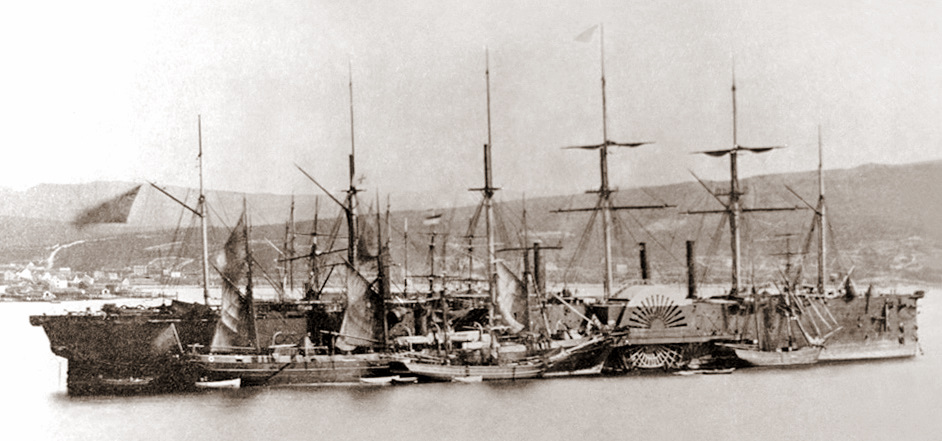
File:Great Eastern 1866-crop.jpgWhen she was launched in the late 1850s she was the biggest ship ever.  She was one of Brunel's great works and yet she did not enjoy much success - on a test cruise one of the boilers blew up after someone decided that safety valves could be sealed off quite safely.  She was launched sideways, which was very unusual.  The ship was amazing yet had an unsuccessful career.  However one of her many claims to fame was to have laid the first transatlantic telegraph cable to last for any length of time.  .-/.-../.-..  ...-/./.-./-.--   --./---/---/-..

HMS Dreadnought (launched 1906)
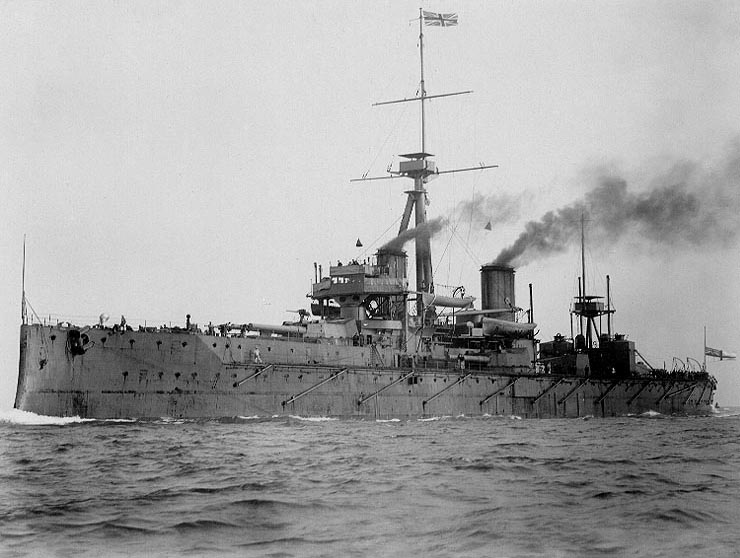
File:HMS Dreadnought 1906 H61017.jpgHMS Dreadnought was the first of the Dreadnought class of warships and was revolutionary in both size and speed.   She was the first ship to use steam turbines and could steam at over 21 knots.  However the only action she saw was when she sank a submarine during WWI.


Yours, most cordially,
JAFHR

iTech