Welcome!

Welcome to theopinionatedinternet.blogspot.com, a whirling hotpot of political opinion, poetry, prose, philosophy, reviewing, and other assorted wild ramblings! Here you will find: PWN, Grand Reviewer and assistant thinker; JAFHR, head of Philosophy, Literature, and Ambassador for France; JHWW, critic/comic materialist; and iTech, computer technician, pilot-in-the-making and co-politician. Fare Thee Well!


Pour les Francophones

Cher Lecteur/lectrice,
Nous vous souhaitons la bienvenue A notre blog, L'Internet Dogmatique. Vous trouverez ici tout votre bonheur- Literature, Philosophie, Politique, Revues, Technologie... Par dessus tout, vous trouverez des opinions. Ne manquez pas a publiez le votre!
Pour rendre tout cet Anglais lisible, traduisez simplement cette page en utilisant le gadget que vous trouverez sur votre droite, un peu en bas. Nous regrettons que cette traduction est rarement exacte; il serait peut-etre plus sage d'utiliser ce blog pour pratiquer votre Anglais.
Bien le Bonjour, Messires et Demoiselles,
JAFHR, le Fou Francophone.

Showing posts with label PWN. Show all posts

Tuesday, June 12, 2012

A Deeper Look at Justin Beiber

Before you stare at shock at this title and whisper things such as 'Good grief, how fickle. Bring back JAFHR's excellent views on philosophy, iTech's fascinating rants about aeroplanes and JHWW's... what does he write about? But anyway, we don't want to listen to this uncultured idiot's views about people who I'm sorry I ever heard of.'

And this would be a perfectly valid view to have, but I implore you to continue reading because there's something deeper behind the superficial nature of this 'artist'. I would also like to point out that 'a deeper look' does not involve... okay, never mind.
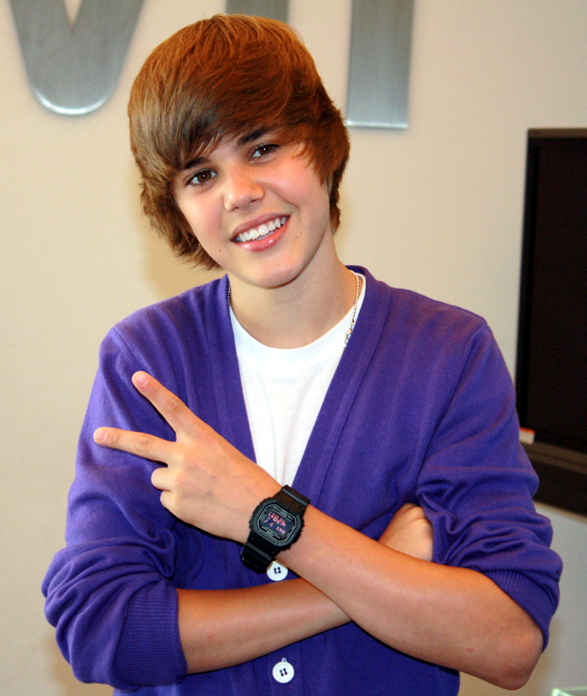
Bieber in New York in 2009

Basically, Justin Bieber is an internationally Canadian successful pop singer. Don't blame Canada, though, he's really as American as South Korea. Most people concentrate on the two things that I think are the least relevant to this post about Bieber: his singing ability and public image. These things though, are relevant to his fame and, to a lesser extent, popularity, so I see it as necessary to cover them briefly, Firstly, Bieber can sing. No matter what you hear his critics say, he gets the notes right and technically the only thing wrong with his voice is that it lacks the emotional depth of a better singer, Adele for instance. This problem could, however, be put down to poor lyrics, but I'll get to that later. The latter aspect of Bieber that people often draw attention to is his public image, which I won't get into too much. To his fans, he is exactly the kind of bland, unintimidating boyfriend every bland American teenager dreams of. To his haters (a group with which I do not associate myself, I might point out), he is a despicable challenge not only to his industry but to his entire gender and thus he has been labelled as many things, starting with the least vulgarity at 'gay' and ending with... well, we shan't get into that.

A shot from Bieber's hit song Boyfriend


Now, the interesting stuff. JAFHR has been going on for a while about materialism, and in Bieber I see his point. His songs, while they could be called love songs, are not about love. I know neither his fans nor haters do, but look at his lyrics. His two most popular song, Baby and Boyfriend, are as materialist as a Texan in a toy store. Baby contains the phrase 'I'll buy you anything', Boyfriend includes the line early on 'I've got some money that I'd really like to blow', while the music video shows him in a series of impossibly shiny cars on an impossibly sunny day singing to several (yes, several) impossibly attractive women. One of the cars he is driving is clearly a Ford Mustang, which is not exactly fitting considering his effeminate image and the fact that the Mustang was mocked even by Top Gear for its overt, arrogant masculinity, but makes a large amount of sense when you consider the ratio between Ford's advertising budget and Bieber's record label's artistic integrity. I'd put it at about 100,000,000 : 0.

An example of the extent of 'Bieber fever'

But what has this got to do with materialism, I hear you philosophy junkies cry. Well, if Bieber can get to the top by being incredibly bland and by pointlessly referencing Starbucks and other equally detestable companies in his songs, then surely this is reflective of our society, and it shines a harsh, damning light. Wait, I hear you cry, you would-be defender of true music, I hate Justin Bieber and so do many people. In fact we threatened to kill him multiple times. Perhaps, but does that really make it any better? I mean, thousands of young males are getting incensed over someone who should really be ignored completely if one wanted him to go away, then doesn't that shine an even harsher light? Hatred is just as bad a response as love in this case, if not worse, partially because no one hates Justin Bieber because of his music. Admittedly, many dislike his music, but often the reason is jealousy that this uninteresting, boylike adolescent should capture the hearts of so many teenage girls.

Justin Bieber isn't Justin Bieber's fault, he's our fault.

-PWN-

While researching this post PWN listened to Justin Bieber's Baby an unhealthy number of times, resulting in a catastrophic collapse of his already poor musical taste. He is currently recovering and will hopefully be fit enough to start writing a post about Frankenstein in a few days.

Friday, May 4, 2012

Hi Again

Apologies for not posting for ages, I simply could not be bothered. I'll just give you an update on what's going on that interests me in the entertainment industry (since no one else on this blog seems to cover entertainment):

- Avengers Assemble isn't terrible.

- Call of Duty Black Ops II is showing innovation (although I have no doubt that Treyarch will double back on its promises and deliver something bland).

- Dishonored is casing a stir, and rightfully so. Again, I have to be cynical and doubt that it will be all that great. However, I've never been right before.

- I've invented a new word. It's absolutely gegassitous.

Now that I've got that out of the way I can get back to pretending to be academic and clever in my posts.
PWN

Saturday, March 10, 2012

Video Games Violence isn't that Bad or: How I Stopped Worrying and Learned to Love Blood and Gore

Please bear in mind that all information given in this post is relevant to the UK only. For information about the age rating system in other countries, please consult this website.

First-person shooter season is over and not only does this mean that EA and Activision have stopped releasing games, it's also given a bunch of people some time to get really rather annoyed. No, it is not the thousands of disappointed fans, shocked to discover that the latest Brawl of Duty: Modern Gorefare game is not quite as new as they had expected it to be, instead, it is those most humble of creatures: parents. They have been shocked as they see the huge amounts of violence in these games, and take to the streets to protest. Sort-of. I would join these protesters and write a long post about how needless violence in games is and all that, but someone else already did that. And they had lots of sciencey stuff in their's, so I can't really compete.

Instead, I shall try to put the arguments of the other side, so often expressed in language that is filled with so much profanity that it is difficult to agree with the ****s. So it is with a slight amount of regret that I dive into my three reasons why people should stop worrying and learn to love blood and gore:

1) The Age Rating System

It is mainly parents who complain about violence in video games. If a game has an age rating which is older than the person who is attempting to purchase it (as long as it is rated by the Entertainment Software Rating Board, not Pan European Game Information which has no legal power inside the UK), then any decent member of retail staff would refuse to sell it to them. If a child is able to buy and play video game of which the parent is unaware then I would blame that on the parent. Does your seven-year-old need to know your credit card number? Really?

2) Violence Exists

The above statement is a fact; violence exists. So isn't it more important to tackle actual violence rather than objecting to events that never really happen or directly harm anyone? However, as the anti-video-game-violence-I-love-hyphens-protester would say, video game violence contributes to real-world violence. But does it? Well... maybe a bit. Despite this, most violence is caused by desperation. Desperation is caused by poverty, poverty is caused by unemployment, unemployment is caused by a lack of jobs and a lack of jobs is caused by the decline of companies. So by campaigning against video games (and therefore the companies that make them), aiming to send them into bankruptcy, aren't anti-video-game-violence-I-love-hyphens-protesters causing real world violence at least as much as the games they hate so very much?

3) The Army

The idea that more people are complaining about video game violence than the existence of the army seems rather strange. There are two reasons why this is happening: firstly, video games are quite an easy target, as they are big companies which are often seen as exploiting the average consumer through over-pricing and suchlike; secondly, significantly more families have directly experienced Call of Duty than front-line combat. An irony that is often pointed out is that one can serve in the army at seventeen, while Call of Duty is rated eighteen-plus. Furthermore, in Northern Africa children are actually being forced to fight by people like Joseph Kony, while here in Europe we're making all this fuss about children playing games which simulate combat (normally in a highly unrealistic manner). Does that make sense to you?


I end with a quote for Hunter S. Thompson (I think that fact that I'm quoting from a man who shot himself aged sixty-seven proves the point I made at the beginning that violence in video games is something to be avoided, but I stand by its relevance nonetheless):


'I hate to advocate drugs, alcohol, violence, or insanity to anyone, but they've always worked for me.'


-PWN-

iFAQ: History

What colour were the dinosaurs?

The fact is, we don't know. There are a few isolated cases where scientists have managed to work out exactly what colour dinosaurs were but for monsters like the Tyrannosaurus Rex, they can only guess. It would probably be a shade of green or brown to provide camouflage, which may sound stupid because Tyrannosauruses were so big they couldn't hide but it did make a difference while hunting, albeit a very small one.

 What was the biggest battle ever?

The biggest recorded battle in English history was the Battle of Towton where one tenth of the English population participated. That is a massive amount of people, however you look at it. It took place in 1461 during the Wars of the Roses and resulted in about 7,000 casualties. The biggest battle ever was probably the Battle of Kursk between the Nazi Germans in World War II and the Russians. It involved about two million soldiers. It took place in Kursk, Russia, in the summer of 1943.

When was the Automobile Invented?

That depends on your definition of 'automobile'. The Ford Model T is the most famous of all the motoring firsts, as the first car to be produced by mass manufacture. The Ford was produced first in 1908, but was only mass manufactured from 1911. Most people would credit Karl Benz with inventing the automobile as we know it in 1885 with the Benz Motorwagen. As early as 1335, the Italian engineer Guido da Vigevano
 designed (and supposedly built) a vehicle that moved using wind power, but this was more of a boat than a car. 

-PWN-

Sunday, March 4, 2012

The Infinite Original Plotlines

I was very much angered to read a list of what are supposed to be the 'seven original plots':

1) [wo]man vs. nature 

2) [wo]man vs. man 

3) [wo]man vs. the environment 

4) [wo]man vs. machines/technology 

5) [wo]man vs. the supernatural 
6) [wo]man vs. self 
7) [wo]man vs. god/religion 


Whoever wrote these is an idiot for the following reasons:

1) These are not plots, they are types of conflict. In fact, they're not even types of conflict, they're types of things that can be engaged in conflict.

2) What about Nature vs. Nature? Or Machines vs. Machines?

3) That list does not help understand anything in the slightest. What's the point of categorizing things in this way?

4) Not every main storyline is about conflict. Admittedly, most are, but what about romance? Okay, perhaps that is conflict, and there could be conflict on the side, but doesn't romance make more sense for a list like this?


I found some other lists that seemed to make more sense and although I find the concept interesting, I don't think it's very important or useful to categorize plots in this way.


-PWN-

Thursday, February 23, 2012

Why The Dark Knight Rises will be Epic (or not)

If you've read even half my posts, you may have gathered that I'm quite a fan of Christopher Nolan (although not quite to the extent that you might think), a veritable Orson Welles among Batman film directors (his other films deserve credit as well though). Therefore I am naturally very excited about his next film, The Dark Knight Rises, out on the 20th of July. So here are five reasons why it's going to be good:

1) Tom Hardy - I initially thought that was an odd choice to play Bane, since I'd always thought of Hardy as the suave British guy from Inception. How can Bane be suave? That doesn't make any sense. But when I heard he was in Bronson and Warrior, it started to make sense. And he actually put on some extra muscle to play the part too, so he ought to be suitably bulky to play Bane, yet I'm sure he'll give the character his own unique twist. He may just be the first good Bane ever to grace the screen (except maybe the Bane from Batman: The Animated Series, which was pretty good).

2) Hans Zimmer - In case you haven't heard his soundtracks for Christopher Nolan's previous films, I shall say that they fit each of the films perfectly, and are in fact good songs just on there own. I can't really phrase Zimmer's composing abilities enough so I won't try to, I'll just say that they're good.

3) Inception - Well if his last film was good, surely his next one will be too? Okay, maybe not. But nonetheless, I can hope.

4) Anne Hathaway - On IMDb, it describes Hathaway's trademark as 'sassy, free-spirited women who attempt to remain independent', which pretty much fits her role as Catwomen. Besides, she can't be worse than Halle Berry (Catwoman, 2004).

5) The Prologue - The first six minutes of the film were released a few months back, so I read a review of it which seemed pretty positive. Overall reception is good (although not great), so can the rest of the film really be much worse?


Well... perhaps. Because there are some things the film has got going against it. Here are a few of them:


1) Heath Ledger - In my opinion, the two best single things about The Dark Knight were the the Joker and the soundtrack. Now, without Heath Ledger as the Joker, it's all down to Hans Zimmer to serve up a stellar soundtrack, but that won't make the film great on it's own. I can only hope that Tom Hardy is a suitable replacement villain.


2) The Trailer - The trailer was pretty poorly received by critics, but to be honest this factor can be ignored because the prologue provides much more detailed information.


3) The Ending - No matter what they do with the ending, it won't work. If Batman dies, it will be the end of that continuity and many people will be annoyed. If Bane dies, it will be too simple. If Catwoman dies, it will be a cliche. If no one dies, it will be too happy for such a dark series.


4) The Bat... thing - How can they possibly explain this? Seriously, when I saw that all the film's realism and grittiness died. Just look at it. Admittedly, it looks good for what it is, but really.


What do I personally think? To be honest, I expect it to be the worst of the trilogy. I know that's going against pretty much everything I said to begin with, but it's true. I just can not see the setup they've got working.


-PWN-

Thursday, February 9, 2012

iFAQ: Science


How fast is the speed of light?

In a vacuum, the speed of light is 299,792,458 metres per second, but it can change. In a prism, light can almost be stopped, while outside of a vacuum, light does not travel as fast, slowed down by numerous particles in the air. Sound, however, travels faster where there are more particles, as that is a wave that relies on particles to move, while light is a wave that does not.


What is the difference between dynamite and TNT?

TNT is not the chemical name for dynamite, nor has dynamite got anything to do with TNT at all. Dynamite is stabilised nitroglycerine wrapped in a cylinder, developed by Alfred Nobel, who later created the fund for the Nobel Prize after feeling guilty about having developed an explosive which was later used in warfare. TNT is an abbreviation of trinitrotoluene, another explosive which is less powerful yet safer to work with than dynamite. However, it has proved to be toxic, causing yellow colouration of skin. This is what caused the female workers in munitions factories to have yellow skin, leading to the nickname 'Canary Girls'. It can also cause organ damage and increased risk of cancer.


What is radar?

Radar, standing for radio detection and ranging, is a device that allows users to detect objects by bouncing radio waves off objects. Its most famous usage was during World War II, when the government spread the rumour that ace pilots were aided in seeing in the dark by carrots, to distract the Germans from the possibility of radar. This mistruth has persisted to this day, although it is true that carrots contain a vitamin necessary for quickly switching between normal vision and night vision, but there is a difference between a lack of something causing damage and an excess of something causing good.

-PWN-

iFAQ: Miscellany


What is an iFAQ?

An iFAQ is not a new Apple product, instead it is something that takes little bit of effort to create (fine, hate me for it). An iFAQ is a collection of infrequently asked questions, because, let's be honest, most questions in other FAQs are never asked by anyone. Some of the questions featured in these were first published in a magazine I used to edit, then later in a blog I edited. Hopefully they won't be republished again. All of them were written by me or a direct associate anyway so I don't think it necessary to make to much of it. In short, the aim of an iFAQ is to provide answers to questions that are seldom asked, but deserve to earn recognition.


How does a turbocharger work?

Turbochargers work by pressurising air entering an engine and adding more fuel to combust it, so that you can get more torque from fewer cylinders. Superchargers are probably different, but as Jeremy Clarkson puts it: "with a supercharger, air goes in, witchcraft happens and you go faster". In reality, superchargers are less sophisticated versions of turbochargers where the pump to increase pressure is mechanically driven, thus taking horsepower from the engine. Some very large superchargers can use more than a hundred horsepower from the engine to keep them running. Superchargers therefore aid top speed, while turbochargers aid acceleration. Turbochargers are more efficient because they utilise exhaust gases, rather than power from the engine.

What is the lowest point in Microsoft Excel?

1048576. If you're wondering how I found this out, press Ctrl and the down key at the same time in an Excel document.

-PWN-

Friday, February 3, 2012

Cheap Classics (Part One - Introduction and Strategy)

Introduction

In this miniseries I'll be looking at some of the best video games that are now available for under £10. Please remember that this is my list and is in no way objective. Please leave any angry opinions in the comments section below. And if you're trying to persuade parents to buy them, they're all rated 12+ or below and are available on PC.

Supreme Commander: Forged Alliance (2007)

I'll cut to the chase here and say that this is really good. Really, really good. I'm not really sure where to start because there's so much to explain, but I'll start by saying what it is I like about it so much and I'll get onto the bad stuff later. Firstly, the  soundtrack is fitting (see my mini-series about video game soundtracks). I know that's an odd thing to start with, but this was really one of the things that made it a much better game for me, and I've been humming it ever since I first played the original. Okay, it might be a bit generic at times but it suits the game's epic scale and military sci-fi style.


Now what is probably the best thing. The scale. This game is epic in every sense of the word. The maps are massive (some take several minutes to cross even with the fastest units), there are at least forty units for each faction (although there are only three factions) and at the highest tech level you can build massive 'experimental' units (like the 'Fatboy' in the picture above). I chose the expansion Forged Alliance mainly because of its campaign and updated interface, both of which are a massive improvements on the previous game, where reviewers pointed out the weaknesses of both.


So what's wrong with it? It pains me to say it, but it is true that in creating a game with such an epic scale some details have been overlooked.  The multiplayer network GPG.net is great for downloading mods but makes it pretty difficult to actually set up a game online. Also, the AI is average at best. Sure it's challenging, but it can never pull off the crazy strategies that someone online is able to. The pathfinding is an improvement on the original, but it's still a little cumbersome and while I like the general aesthetic of the game, it's nothing new and some may find it a little too blocky.

If you want to buy this game, it's now on Steam for £9.99 (or £14.99 for the original as well) or order it on  Amazon for slightly less.

Rome: Total War (2003)


Widely accepted as one of the best strategy games of all time, it is my personal favorite of the entire Total War series because of its simplicity, realism and soul. Everything has been thought through and it is a definite improvement on Shogun and Medieval, unlike the modern games which are all a bit similar, not building enough on the previous games (I'm talking about Empire and Napoleon, Shogun II I haven't played).


I can't really think of anything bad about this game, except that I hated the expansions (although I must admit I barely played either of them, the just didn't grab my interest) and the fact that there is no naval combat. This was only introduced two games later, in Empire, when really this was the game that needed ship combat and in Empire it was far too late. Also, the multiplayer is somewhat limited. I don't know what I wanted from it, but I didn't get it.

The reason I love it is because it is so realistic, yet also so much fun. It combines turn-based and real-time strategy perfectly. If you want to just be a Roman general, then just play skirmishes all the time. If you want to conquer the world, then auto-resolve all of the battles. There's not much more I can say, sorry this has been so short. It's really cheap now to, so check it out on Steam or  Amazon, just avoid the expansions.


Age of Empires II: Age of Kings (1999)


While I haven't played it for a while, this remains the definitive real-time strategy (RTS) game because of its simplicity and its personality. As soon as you see the title screen, you'll realize that this is a properly heartfelt game. Before I get any further, I'd like to say that this is not realisitic in the same way as Rome: Total War or even Supreme Commander. Instead of expecting a historical game, expect an RTS that incorporates parts of history into it. This is perhaps what makes it so enjoyable. In the end, the game mechanics are simple, and I was constantly frustrated with the lack of strategic zoom that Supreme Commander made such great use of. But when you consider that this is a really old game, it's perfectly excusable.


I played this a lot when I was a lot younger (about six or seven years old) because it was so simple to understand. It did take me a while to work out what some more complicated things do (such as advancing an epoch), which severely limited my chances of winning any games. Despite this, I loved it and I think that it deserves some recognition, as new maps can always be made using the excellent map editor. If mythology  (I'm looking at you, JAFHR) or the colonization of America is more your cup of tea, then there are sequels that fill those niches, although in my opinion none were quite as good as the second game (the first is a little too dated).

It's now available on Amazon for about £10.

                                                                        -PWN-

P.S. Sorry, about the weird spacing. I think it's something to do with the picture, I'll try and fix it later.

Thursday, February 2, 2012

The Five Best Video Game Soundtracks of All Time


Need I even explain this? Sure, it doesn't really fit the rest of the game, but it's so memorable, I didn't care, and neither should you. Just love it. I might get a bit hate for not mentioning the Battlefield 3 soundtrack. The reason I didn't mention it is that I thought that the extra distortion didn't add the piece. I liked it and it suited the game, but to me the instrumental version is unbeatable.

2) Halo 3

This is a nice, orchestral piece. That's pretty much it. It fits the scale of the game, I suppose, but I always thought it was building up to something that didn't really deliver. I mean, wasn't Reach supposed to be the emotional climax? From this trailer you'd think that Halo 3 was meant to be the end of it all, and the music gives the same message. Oh well, maybe it's just me. I always thought that the Reach soundtrack was a little less emotional, despite the ending and the overall mood being more emotionally engaging.


Personally, I've never played Skyrim and I'm not a huge fan of the soundtrack but I have to admit, it gets the atmosphere across pretty effectively. I don't like the whole singing thing in Fus-Ro-Dah, and in the soundtrack I chose for the link in the title I thought it was a little less... stupid. In it, I felt that the singing added to the orchestral feel rather than acting like a massive distraction. In both cases, however, the actual tune is really good, I just didn't like the voices. It might just be something to do with getting caught up into the hype of the game, since all the people I know who like this theme play Skyrim.


I'm probably being a bit too negative, as this is my number 3 choice. It's just that I thought the singing was a bit of a cliche, although it's probably the best example of it that I've seen. Also, it's good that they're actually singing what could be considered a language, not just saying nonsense.


It's simple, yes, but that's the point. This soundtrack is creepy, sad, memorable and beautiful in equal measure, much like the game. All the tracks are brilliant simply because they're so simple. If a soundtrack ever fitted a game, this one does. Admittedly, it's not as polished as, say, Halo's but it doesn't matter. I think of them as a pure reflection of what I felt while playing Minecraft, which I know is a corny thing to say but it's true. I put the 'Calm 3' track link in the title because I thought it summed up everything I said best, but that's just my opinion and the others are also excellent. Perhaps the best thing about these songs is that they really capture the loneliness that is the core of the game (at least in singleplayer).


It may be generically militaristic, but this theme is surprisingly good for a real time strategy game. It works very well in game, and there are plenty of tracks so that they get familiar, but never boring. My choice was Risk, Relief and Victory, because I think that it has the most universal appeal, but the others are also good.

-PWN-

Tuesday, January 24, 2012

Is Life an Illusion?


“The world is a stage and its men and women are merely its actors” William Shakespeare.


PWN - I believe that the world is in fact a video game, kinda like the Matrix.

JAFHR- What proof have you to state that the world is fake?

PWN - Ahm, well let’s not get bogged down in details here.

JAFHR- The French philosopher Descartes wrote that we cannot be sure of anything- “what if some evil genie was making me believe my hand is where it is?” He then realised that, in this world or another, two plus two will always equal four. Thus he set up the Cartesian School- a school of thinking which looks at things from a mathematical point of view. We can look at a circle, and be sure that it exists because it is possible to work out that it is a circle. We can now see that the world cannot be fake, for it is made up of maths.

PWN - Maths was built around the world, not the other way around.

JAFHR- Really? When you study circles, does the teacher bother about demonstrating that a perfect circle exists? As you said, let’s not get bogged down to details; a circle exists in theory, and a philosopher would argue that the world is a theory.

PWN - Could we get back to the point please?

JAFHR- Is this not the point?

PWN - Not really, can’t we just discuss the practical points of this before the philosophical implications?


JAFHR- What is this practical point, then?

PWN - Like... whether it would be possible to make a ‘dream world’. If you think of the improvements in video game graphics and immersion over the past ten years, is it not feasible, or even likely that in the future we will develop some kind of completely immersive game where we think the game is real. If that is the case, then it seems highly likely that we are already in the game. I’d like to point out now that I did not like the Matrix, but it is a good example of this.

JAFHR- Many theologians would say that the world is indeed a computer game, and the ‘Grand Engineer’ (in the words of Voltaire) is God.
PWN - That’s a very good point. If our world has been engineered, then does it matter?
JAFHR- It does not, however you would need to prove His existence.
PWN - Which is pretty much impossible. But if God is not necessarily perfect, then why doesn’t He blow stuff up and such, rather than act rather passively. Doesn’t He get bored? Or is that part of the human condition?
JAFHR- I think Christian, Jewish and Muslim theologies all agree that god is perfect, and, if you trust that he exists, you trust that he is perfect. In my memory, only one religion believes in a bad single god; a secretive tribe in an island off Mexico, the name of which escapes me. These people believed this because the conditions of the island were so dreadful; to them, he did indeed ‘blow stuff up’. This is possibly comparable to the game “Pocket God”, available on the Apple App store.
In most mythologies, there are many gods- they are like the many admins of this blog; there are some “good Gods” (me) and some “bad” gods (JHWW) who try to destroy what the good gods have made.In this scenario the bad gods are like enemy players in a Multi-player, or possibly the baddies in any respectable game. I personally believe that the gods are players just the same as we are, but that is another story. Whether we have a unique god or multiplayers, it is clear that, if the world is a computer game, it is clear that a certain someone has taken a great deal of care to make it so that we, the WoW players, could enjoy it in the fullest. If life is a computer game, does that make it any less real, then?
PWN - No,but onto a more practical point -  why would anyone want to convince us that we are in the real world when in fact we’re not? In the Matrix it’s because the real world is ruled by machines and they don’t want any humans messing up their stuff so they create this ‘Matrix’ thing, which is essentially a simulation of the year 2000 (the film is set in 2200 or something). Would they be exploiting us for money, or keeping us out of the way? Why not just drug or kill us?
JAFHR- If the 'Machines' you are talking about can be called gods-which by definition they are- then see my previous response to see why the gods do not "blow things up".I have just argued extensively that the world cannot be false - perhaps there is a bigger world out there,like at the end of every MIB film, but certainly nothing which we need to be aware of.
PWN - I suppose you are right. The bigger world is somewhat irrelevant if nothing we can do can allow us to experience it. On that note, I think we should end this discussion. Please leave your own opinion in the comments below.
JAFHR- Yes, indeed, good day.


-JAFHR-

Saturday, January 21, 2012

Television Review: Sherlock Season 2

WARNING: This review contains spoilers


Episode 1: A Scandal in Belgravia


I'm not trying to be the clever person here, so I'll admit that I prefer the new Sherlock series to many of the books. While it may not be fair to compare the two mediums, in my opinion the television program is wittier and more imaginative. That's not to say I didn't like the books, I loved them, but after a few years of popularity they slowly started to decrease in quality. Thank God I don't have to say the same thing about this show. I saw the first season back in 2011 on DVD and instantly loved it, spending hours watching it while I should have been doing homework, so it would have been almost as great a disappointment for this to be inadequate as if Batman Begins had been bad (I saw The Dark Knight first).


Irene Adler proved a suitable villain/antihero/love interest, although it threw Watson into the shadows somewhat. Fortunately he is often able to break up Sherlock and Irene with hilarious quips, making this the funniest Sherlock episode so far. There's not much more to say about it, except that it was amazing.

Episode 2: The Hounds of Baskerville

Reviews of this episode have been positive. Why? For goodness' sake, this was by far the worst Sherlock episode of the season, even the worst episode ever. That's right, I said it. What was Mark Gatiss thinking? Was he too busy acting Mycroft to write something decent? Quite possibly. More likely is that he used up all his good ideas on Doctor Who, but that doesn't make sense because Doctor Who is terrible too.

Anyway, maybe I'm being a little harsh on the episode. What exactly was wrong with it? Well it was just too slow, too obvious and not at all Sherlock-y. I generally turn off my brain while watching Sherlock, not because it's too simple, but because I would get so confused if I tried to work out what was going on that I would have to smash my TV screen. This time, however, even I figured out what the end was going to be halfway through. Mark wrote The Great Game (Episode 3 of Season 1) and that was brilliant, but the characterization of the minor villains was non-existent. Maybe this wasn't such a bad thing, but doing it in The Hounds of Baskerville doesn't work. I mean the villain must have had about five minutes of screen time, and his motivations were never explained. And the plot is not original. Firstly it was based very heavily on the book, and secondly, everything else is stolen from somewhere else. A Chemical weapons factory, a secret government project, a homicidal scientist in a gas mask, hallucinating worst fears...


Alright, I may be focusing on the bad stuff. I guess I did like the way it was shot, the acting was excellent (as usual) and the first twenty minutes lacked the problems of the rest of the episode. Also, the plot did allow for some expansion on the relationship between Holmes and Watson, but it wasn't quite funny enough. There were only two witty moments in the script. But I don't want to go back into that rant, so I'll just conclude. If I were to put a number (out of ten) on this it would a seven, which isn't bad, but the standard of writing is normally so much better I was thoroughly disappointed. It just felt like a typical detective show, not the best live-action television series I have ever seen.

Episode 3: The Reichenbach Fall

Good grief. It's good. It's very good. You liked the last finale, you'll love this. The rooftop scene, the graveyard scene, the heist scene... every scene was memorable. And the bit where (if you didn't read the earlier warning about spoilers, read it now) Moriarty shoots himself. I don't have to talk for long about this, because everything was almost perfect, I'll just do some nitpicking. My only real problem with the episode was that I never really believed that Sherlock might not be everything he said he was, and I also never really believed that he was dead (well... maybe for a second or two). I would have liked it if it had actually made these possibilities a bit more believable, but it was so packed with emotion that I didn't really mind. It's just a shame that that was it...


Fortunately the writers have said that 'hopefully before the year's out', Season 2 will air on BBC 1. That means I have something epic everything six months, with The Dark Knight Rises coming out in the summer. I can't wait to review that.

My Weird World of Fashion

I know barely anything about fashion. In fact, I don't even know what the word means. Here's some definition from the Google dictionary:  'A popular trend, esp. in styles of dress, ornament, or behavior.' You have noticed that I rather like trilby hats. The only reason for this is that I saw one in a charity shop for £3. I don't buy any of my clothes first-hand. In fact, half my clothes are from my cousin. The one thing I know about fashion I know from my grandmother, and this is this: 'Green bathtubs are out'. That's it. Really.

So then, what am I going to fill this page with? That is a good question. I'm not really sure. Perhaps I do, unconsciously know more about style than I think. However, I ought to distance style and fashion at this point. Style is (almost) constant, there are many things which are stylish, some of which I own (iPad 2, Skullcandy headphones), but that is not the same as fashion. Style is understated and elegant, fashion is all about being as outlandish as possible because everything sensible that can be done has been done. That's just the way I see, if you want to rage at me in the comments then go ahead.

Friday, January 20, 2012

Life of Pie


Yes, I've taken to naming my introductions after 21st novels. I guess I ought to explain a little about myself before starting to write proper content. Why 'Life of Pie'? I don't know, I like pie. So here's all I'm saying about myself, it's a kinda pie of information. No, no, I'm sorry. That was a terrible simile. Anyway, here it is the 'pie':

1) My initials are PWN. I'll let you guess my middle name.

2) I am a real person.

3) I go to some kind of school.

4) My favorite animal is the elephant.

5) My favorite colour* is beige.

6) *Yes, I'm English.

7) My favorite films are 'The Dark Knight' and 'Inception'.

8) My favorite game used to be Minecraft but now it's Supreme Commander (this will change every month or so).

9) On Youtube, I like watching the Yogscast, Nostalgia Critic and Totalbiscuit.

10) I will never release such boring information again.

Thursday, January 19, 2012

A Sense of a Beginning

Alright, I've been thinking. And I've realized that the majority of good  reviews content is biased in some way, that is, based on opinion and making no attempt to provide anything a level playing field. Is this necessarily a bad thing? No, after all, the web is all about expressing opinions freely and in theory one needs only one unbiased reviews website to serve the entire internet. But the trouble with that is, if it shows any kind of bias then it gets yelled off the web. So don't say that this is biased, because that's the idea.

Now then, there are three problems with the name of my blog. The first is with the word 'the'. 'The' is what's called the definite article, implying that this is the only place on the entire internet which is opinionated, while obviously it is not. Secondly, 'opinionated' isn't really the best way to describe this blog, as sometimes I will attempt to be unbiased. Thirdly, and most pedantically, the word 'internet' should not be used to describe the web because they are not the same thing ('internet' means the hardware (all the wires and such), while 'web' refers to the information stored and transferred on it - I'm sure there are better definitions but that's my understanding). Therefore, a much better title would be: 'A Biased Web', but that sounds ghastly so I 

Now some people who will not enjoy this blog:

1) Idiots (you won't understand what I'm saying).

2) People without internet connections (now that I've ruled out the first category, need I explain it?).

3) Geniuses (you'll find me patronizing and annoying).

After all, something showing bias cannot be for everyone by definition. I ought to explain what I'll be writing, so here are some of the titles you might see in capitals in front of posts:

INTRODUCTION - I might post some more introductions to explain some other details about the blog and all.

ANNOUNCEMENT - If something interesting happens, such as a new author joining the blog, then I'll post one of these.

OPINION - Probably making up the bulk of posts, opinion posts consist of my (or another author's) opinion on a certain subject.

REVIEW - Speaks for itself really, although if you looking for balanced, fair reviews you might want to look elsewhere

INTERVIEW - If we manage to get someone famous or noteworthy to agree, we might interview them and post it onto the blog, but this will be quite rare.

ARGUMENT - A transcript of an argument between me or one of the other authors with someone else about a subject on which they disagree.

INFORMATION - A rather stale and dull look at some piece of information, such as a list of admins, authors

And some you'll only see in front of my posts:

iFAQ - inFrequently Asked Questions, because let's be honest, the majority of 'frequently asked questions' never get asked.

Also note that every article I will post a different picture of a trilby hat, in the same way that JAFHR will post a picture of a god from ancient mythology.

I may add to this introduction later, or post further ones with additional information.